The short answer. Children's home management software is a platform for recording care, managing staff and evidencing compliance in Ofsted registered children's homes. The main thing to check is that it is built for the Children's Homes (England) Regulations 2015 rather than adapted from adult social care, because the records, notifications and inspection cycle are entirely different.
Buying checklist updated 18 September 2026. Regulatory references last reviewed 13 August 2026.
Buying software for a children's home is unusually easy to get wrong, because the market looks larger than it is. Search for care management software and you will find dozens of well established products, many of them built for adult residential and nursing homes regulated by the Care Quality Commission. They demo well. They are often cheaper. And they are built around a different set of legal duties.
This guide covers what a children's home actually needs the software to do, the questions worth asking any supplier, how the options compare, and the mistakes that cost providers the most.
What are the benefits of a care home management system?
For a children's home, the useful benefits are changes staff and managers can see in everyday work. Test whether the system helps your team:
- Reduce repeated entry. Reuse relevant information across daily records, care plans and reports without copying the same update into several places.
- Make handovers clearer. Find recent changes, outstanding actions and the person responsible for following up.
- Keep oversight consistent. Check incomplete records and overdue actions across shifts or homes, with access appropriate to each role.
- Retrieve evidence faster. Follow a record from the original entry through management review and the resulting action.
These are outcomes to test, not guaranteed savings. Use a typical shift or review task from your home to compare the new system with your current process.
Why children's home software is not care home software
A nursing home and a children's home both keep care records, so the products look interchangeable at a distance. The duties underneath them are not.
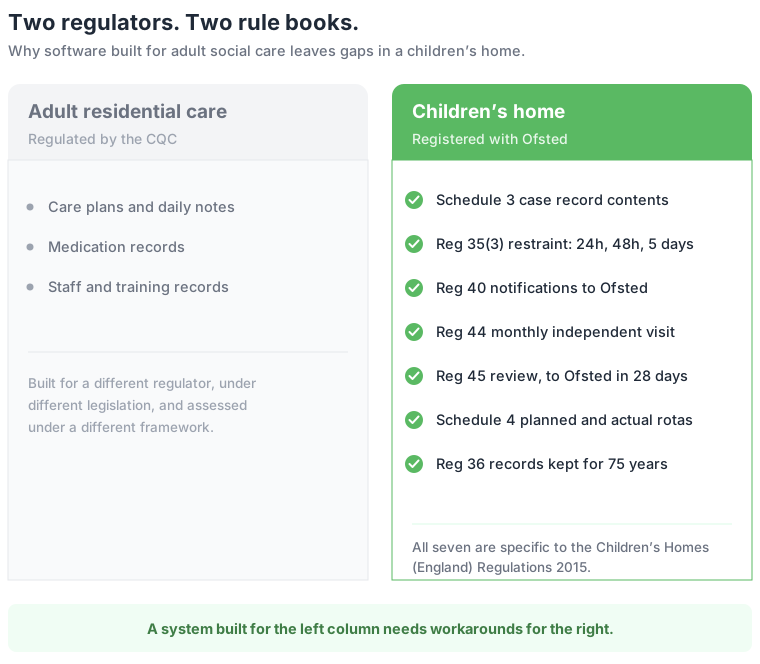
An adult residential home is regulated by the CQC under the Health and Social Care Act 2008. A children's home is registered with Ofsted, regulated under the Care Standards Act 2000 and the Children's Homes (England) Regulations 2015, and inspected under the Social Care Common Inspection Framework. Different regulator, different regulations, different inspection framework, different records.
In practice, adult care software tends to be missing:
- Schedule 3 structure. A children's case record has a defined content list covering placing authority details, missing episodes, restraint, contact arrangements, school reports, EHC plans and more. Adult systems have no equivalent and end up storing these as loose notes.
- Regulation 40 notifications. The duty to notify Ofsted of serious events, with the required content and the written confirmation, has no analogue in the CQC world.
- The Regulation 44 and 45 cycle. Monthly independent visits and six monthly quality of care reviews are specific to this sector, and the review report has to reach Ofsted within 28 days.
- Restraint recording to Regulation 35(3). Eight required details within 24 hours, sign off within 48 hours, confirmation the child was spoken to within 5 days. Generic incident forms do not enforce any of that.
- Missing from care recording. Including information about where the child was during the absence, not just times out and back.
- Planned against actual rotas. Schedule 4 requires both. Most systems keep only the published rota.
None of this makes adult care software bad. It makes it the wrong shape. The cost shows up later, as workarounds: a spreadsheet for notifications, a folder for Regulation 44 reports, a separate rota tool, and a manager reassembling evidence by hand before every inspection.
One further complication if you run mixed provision: supported accommodation is a third framework again. Providers registered under the supported accommodation regulations have their own requirements, and a platform that treats a 17 year old in supported accommodation as though they were a child in a children's home will produce records that do not fit either.
What the software has to support
The table below maps the main regulatory duties to what that means for a system. It is a reasonable specification to hand a supplier.
| Duty | What it requires | What to look for |
|---|---|---|
| Reg 36 and Schedule 3 | A case record per child with defined contents, kept up to date, every entry signed and dated by its author | Per entry attribution that cannot be shared or spoofed, and a structure that maps to Schedule 3 rather than free text |
| Reg 37 and Schedule 4 | Register of children, staff records, planned and actual duty rosters, visitors, fire drills, accounts | Rota that records what was worked, not only what was planned. A visitor log that is actually used. |
| Reg 35(3) | Restraint recorded within 24 hours with eight specified details, signed off at 48 hours, child spoken to within 5 days | Required fields matching the eight items, and prompts that hold the record open for the later steps |
| Reg 40 | Notify Ofsted and others of serious events, in writing, with details of the matter, who else was told, and action taken | Notification linked to the underlying incident record, so the trail is traceable afterwards |
| Reg 39 | Complaints recorded with action and outcome, and a 12 month summary available on request | One click production of that summary |
| Reg 44 | Monthly independent visit and report | Controlled access for the independent person, and a place the reports live |
| Reg 45 | Six monthly quality of care review, report to Ofsted within 28 days | Reporting that aggregates incidents, complaints, missing episodes and children's views across the period |
| Reg 38 | Listed records kept accessible, and expressly permitted in electronic form | Retrieval in seconds, including for staff who are not the manager |
| Reg 36(2) | Case records kept 75 years from date of birth | A credible answer to what happens to those records in 20 years, or if you change supplier |
| Regs 32 and 33, and Schedule 2 | Schedule 2 fitness information for everyone working at the home, plus supervision, training and appraisal under Regulation 33 | HR held in the same system as care records, not a separate product |
If you want the detail behind the records rows, we have covered what the Regulations require on record keeping separately.
The questions worth asking every supplier
Demos are designed to show strengths. These questions are designed to find the edges. Ask them of every supplier, including us.
Regulatory fit
- How many Ofsted registered children's homes use this product today, and can I speak to two of them without you on the call?
- Show me the restraint record. Does it enforce the eight items in Regulation 35(3), and what happens at 48 hours if nobody has signed it off?
- Show me how a Regulation 40 notification is raised from an incident, and what the record looks like afterwards.
- Produce a Regulation 45 evidence pack for a six month period, live, from demo data.
- How does the system handle supported accommodation differently from a children's home, if at all?
- When the SCCIF or the Regulations change, who updates the product, and how quickly did you respond to the April 2026 update?
Records and audit trail
- Can two people share a login? If so, how do you meet the requirement that each entry is signed and dated by its author?
- Can an entry be edited after it is saved? Who can, is the original preserved, and can I see the version history?
- Can anything be deleted, and by whom? What is recoverable?
- Show me the audit log for a single record over six months.
- How do I see, today, which records are incomplete across the home?
Data, exit and the 75 year problem
This is the section buyers skip and later regret. Case records must be kept for 75 years from the child's date of birth. No software contract runs that long.
- If we leave, what exactly do we get back, in what format, and how long does it take?
- Is the export a usable record, or a database dump nobody can read? Ask to see a sample export from a real departing customer.
- Is there a charge for export or for extended access during transition?
- Where is the data hosted, and is it held in the UK?
- What happens to our records if your company is sold or ceases trading?
Security and information governance
- What certifications do you hold, and can I see the certificate rather than the badge on your website? Cyber Essentials Plus and the NHS Data Security and Protection Toolkit are the ones that carry weight here.
- Who are your sub-processors, and where do they operate?
- Will you support our Data Protection Impact Assessment, and do you have a template?
- How is access controlled between homes in a multi-site group?
- What is your breach notification process and timescale?
Whether frontline staff will actually use it
- How many taps to log a daily entry on a phone, mid shift, one handed?
- What happens when the wifi drops in a bedroom at the back of the house?
- How long does it take to train a new agency worker to record safely?
- Can a child see their own record, and is it written in a form that makes sense to them?
Implementation and support
- Who does the migration from paper, and what does it include?
- What is a realistic go live timescale for one home, and for six?
- Is support UK based, and does it understand children's homes or only the software?
- What does it cost to add a home, and how quickly can it be set up?
Commercial terms
- Is pricing per home, per bed, per user, or per occupied bed? Occupancy varies, and the answer changes your bill.
- What is not included: implementation, training, migration, support tiers, extra modules?
- What is the contract length and the notice period?
- How much has the price risen for existing customers over the past three years?
Take this list to your shortlist. If you would rather have it as a printable document alongside a broader inspection readiness review, our Ofsted readiness checklist is free to download with no sales call attached.
How the options compare
Four broad routes, with an honest read on each.
| Approach | Works when | Breaks when |
|---|---|---|
| Paper, plus a shared drive | One home, stable staff team, a manager who knows where everything is | Retention over decades, evidence gathering under inspection pressure, attribution of entries, and any growth at all |
| Adult social care software | You mainly need daily notes and medication, and you accept manual workarounds | Regulation 40, 44 and 45 workflows, Schedule 3 structure, missing episodes, restraint timescales |
| Several point tools stitched together | Each tool is strong in its area and you have someone to join them up | Duplicate entry, records that contradict each other, and no single view for a Regulation 45 review |
| Specialist children's platform | You want the regulatory workflow built in and one place for care, HR and reporting | The market is smaller, so check the supplier's depth, roadmap and exit terms carefully |
The honest caveat on the last row, which applies to us as much as anyone: a specialist market means fewer suppliers and more concentration risk. That is exactly why the data and exit questions above matter.
How to compare care home management systems for ease of use
Ask each shortlisted supplier to let a frontline worker and a manager complete the same five tasks using fictional demo records:
- Record a daily update on a phone. Check how easily staff find the right record and review what they have written.
- Hand an action to the next shift. Find the owner, due date and completion status without searching several screens.
- Review a change to a care plan. Check that authorised staff can find the current version and trace an earlier change.
- Find an incomplete record. Ask the manager to identify what is missing and show how follow-up is recorded.
- Retrieve and export a record. Check that the output is readable and includes the information your team needs.
For each task, note completion time, steps taken, mistakes and help needed. Test on the devices your staff actually use, ask what happens when the connection drops, and repeat after a short introduction. Compare the observed results alongside security, costs and support.
How pricing usually works
We are not going to publish other suppliers' numbers, because they change and they are usually negotiated. What is worth understanding is the shape of the pricing, because it determines what you pay as you grow.
- Per home or per site. Predictable, and usually best if your homes are small.
- Per bed or per occupied bed. Scales with capacity. Check whether you pay for empty beds, which matters during a placement gap.
- Per user. Watch this one if you use relief or agency staff, since the count moves and can rise sharply.
- Implementation and migration. Usually separate, sometimes substantial. Get it quoted before you sign, not after.
- Modules. HR, rostering, property and reporting are sometimes priced separately. An all-in quote and a modular quote can look very different at year three.
Ask every supplier for a three year total cost including implementation, training and expected growth, rather than a monthly figure. That single question makes quotes comparable.
Five mistakes buyers make
- Buying on the demo rather than on your own case. A demo shows the product working the way it was designed to be shown. Ask the supplier to walk through a real situation from your home instead.
- Not involving frontline staff until go live. The people who resist a system are usually the people who were never asked. A single support worker in the selection meeting changes adoption more than any training plan.
- Ignoring the exit. Every provider thinks about getting in. Very few ask what leaving looks like, and by then it is contractual.
- Migrating everything. Bulk scanning years of paper into a new system creates a searchable pile, not a record. Be deliberate about what moves.
- Choosing on price alone in a small market. The cheapest quote often excludes migration, training and the modules you will need by month six.
Moving from paper without losing the audit trail
The most common anxiety, and the most manageable one. What tends to work:
- Start with new entries, not old ones. From go live, everything new goes in the system. Nothing is retyped.
- Move current children's live documents. Care plans, placement plans, risk assessments, current health information for children in the home now.
- Load the archive if the platform can hold it. Closed records still have to be retained, for 75 years from date of birth in the case of children's case records. If your system can store them, put them there. It keeps everything retrievable in one place and removes the dependency on a physical cupboard in a specific building, which is the part of paper storage that fails over that kind of timescale. Check first whether archived records count towards your storage or licence cost.
- Keep the paper originals until you are sure. Retention duties do not pause during migration.
What is changing in 2026
Three developments are worth factoring into a purchase this year.
The children's homes SCCIF was updated in April 2026. The judgement structure is unchanged, but the emphasis on children's lived experience and on case tracking has sharpened, which puts more weight on whether your records show what actually happened for a specific child rather than that a process was followed.
Ofsted has also been consulting on strengthening children's social care inspections, with the consultation open until late September 2026. Nothing there is settled, so treat it as direction of travel rather than requirement, but it is a fair question to put to a supplier: how do you track and respond to changes like this?
Finally, Annex A expectations have tightened around demonstrating oversight and patterns rather than listing incidents. A system that stores incidents but cannot show themes across a period will make that harder than it needs to be.
Where OVcare fits
We build for Ofsted registered settings specifically: children's homes, supported accommodation and family assessment centres. Care records, incidents and restraint, notifications, HR and workforce, property and reporting sit in one platform rather than four, with entries attributed and timestamped, and evidence retrievable in one place rather than assembled by hand.
Where we are not the right answer: if you run adult residential or nursing services and need CQC aligned tooling, a specialist adult provider will serve you better. If you have one small home, no growth plans and a paper system that genuinely works, the case for change is weaker and we would rather say so.
Explore OVcare's children's home software for daily records, care planning and workforce oversight. For provision operating as supported accommodation, see our supported accommodation software for support plans, independence goals and oversight across properties.
Test us against this guide. Bring the supplier questions above with you. Book a free demo and we will work through them with your setting in mind rather than run a feature tour.
Frequently asked questions
What is children's home management software?
A platform used by Ofsted registered children's homes to record care, manage staff and evidence compliance. It typically covers children's case records, daily logs, incidents and restraint, missing episodes, care planning, notifications, HR and training records, rotas, and reporting for Regulation 45 reviews and inspection.
Is digital record keeping allowed in children's homes?
Yes. Regulation 38 of the Children's Homes (England) Regulations 2015 states expressly that the listed records may be kept in electronic form, provided they are kept in an accessible manner. There is no requirement to keep paper records.
Can we use adult care home software in a children's home?
You can, and some providers do, but it is not built for the duties that apply. Expect to build workarounds for Schedule 3 case record structure, Regulation 40 notifications, Regulation 35 restraint timescales, missing episode recording and the Regulation 44 and 45 cycle.
How much does children's home software cost?
Pricing is usually per home, per bed or per user, with implementation and migration quoted separately. Rather than comparing monthly figures, ask each supplier for a three year total including implementation, training and your expected growth.
How long does it take to switch systems?
For a single home, a few weeks is realistic if you move live documents rather than the full archive. For a group, run one home first and use it to settle your configuration before rolling out. Migrating everything at once across every site is where timelines slip.
Does the same software work for supported accommodation?
Only if it has been built to handle both, since supported accommodation providers are registered under a separate framework with its own requirements. Ask specifically how the two are configured differently rather than assuming one covers the other.
A note on scope. This article is general information about the position in England and is not legal advice or a procurement recommendation. It does not replace the professional judgement of the registered person or responsible individual. Requirements change, so check primary sources before relying on any point here. OVcare is a software supplier and this guide is published by us, which you should weigh accordingly.
Sources: The Children's Homes (England) Regulations 2015 (SI 2015/541). Ofsted, Social care common inspection framework (SCCIF): children's homes, updated April 2026. Department for Education, Guide to the Children's Homes Regulations including the quality standards. Ofsted consultation on strengthening children's social care inspections, July 2026.
Related practical guides
Continue with these closely related OVcare guides: